
Pour plus d' informationes sur les
resultates de la concours et les Gangnants,
ainsi que nos Offres pour la representation de l'opera
cliquez ici (anglais)
http://www.idyllion.gr/libe.htm
« Hellenikon Idyllion », le centre grec artistique et culturel sur la côte nord-ouest du Péloponnèse, organise un concours de composition sur un livret à l'honneur d’un projet archéologique pour la détection et pour les fouilles de l'ancienne ville célèbre de Helice situé aux environs de Egion.
Notre concours veut motiver à particier ceux qui - comme nous - voient par amour et par enthousiasme dans cette idée, dans ce but un défi particulier, qui sera fait cadeau à eux-mêmes. Dans nos capacités nous allons aider tous ces à présenter leur travail et de faîter ensemble. Pour les vainqueurs et tous les participants une couronne d'olivier devrait être motivation, car ils ont d'abord aimé surtout leur propre travail.
L'objectif du concours est de « traduire » le livret en musique. L'histoire du livret vient d'une idée de Andreas Drekis, fondateur du Hellenikon Idyllion, elle était réalisée littéraire et textuelle en grec ancien par Franz Knappik, M. A. en philosophie, grec et musicologie (LMU Munich).
En 1990 les recherches archéologiques d'après la ville engloutie, Helice, ont commencé. La ville fut probablement détruite en 372 avant J.-C. par un tremblement de terre et par les inondations subséquentes. Environ 500 ans plus tard Pausanias a mentionné d’avoir vu ces ruines sur le fond marin dans son livre « Voyage en Grèce » et il écrivait très détaillé sur la ville et ses habitants. Le « naufrage » de Helice est mentionné par plusieurs écrivains de l’époque. Pour plus d'information veuillez cliquer sur la partie appropriée de notre site d'http://www.idyllion.gr/NewsD.htm .
La fait que, depuis près de 20 ans de la recherche la ville est toujours pas trouvée, a donné l’impulsion pour le livret. Mais les éléments de preuve nouvellement découverts l'an dernier indiquent que Helice, la grande ville avec son Temple de Poséidon et sa statue de bronze de Poséidon - attestée par écrit - et avec son Agora, sera découverte à très bientôt.
L’histoire de livret suit deux lignes: d’un côté un couple dans l’antiquité qui survécu au tremblement de terre et à la destruction tragique de sa ville natale, y compris l'extinction de tous ses voisins, de l’autre côté les joies spirituelles d’un symposium et de l’amour suscitent l’intérêt.
Un tournant dans la dramaturgie est marqué par un changement dans « l'avenir », c. a. d. notre présence, quand 2.500 ans après une équipe d'archéologues se met à la recherche de la ville engloutie. Cette recherche est ébranlée par un deuxième tremblement de terre, pas si fort que le premier, et au lieu ou l'archéologue grecque mène actuellement des recherches, une partie des ruines imposantes du temple et la statue du dieu Poséidon devient visible. Le succès des recherches persistantes est certaine: tout l'ensemble du site est excavé. À la fin de l’opéra une fête triomphale est donné à l'honneur de l'archéologie et à la culture grecque classique, avec des chants en chœur et des danses grecques anciennes et modernes.
Le contraste entre l’histoire fictive dans la ville l'ancienne et les progrès des travaux modernes scientifiques archéologiques, qui avec la détection de Helice donnent raison à la préconisation de l’archéologie, ainsi que y intégré le scénario du destin des deux amants qui survivent l’histoire, caractérise le livret passionnant.
Les chants et les chœurs en grec ancien ainsi le colloque philosophique montrent la beauté du grec ancien et le pouvoir de l'esprit libre. Pour éviter les barrières linguistiques et pour permettre une présentation dans une autre langue, le livret est disponible en anglais, allemand et français, y compris la transcription phonétique du grec ancien à l'alphabet latin. La connaissance de la langue du grec ancien donc n’est pas nécessaire. Sur www.idyllion.gr une impression acoustique d'un extrait du livret en grec ancien est à la disposition. Les personnes qui s’intéressent à participer au concours, reçoivent le livret entier en forme phonétique en caractères latins (prononciation Erasmus) ainsi que plusieurs fichiers acoustiques.
Les candidats sont demandés de présenter l’esthétique et la dynamique de la langue du grec ancien et de la culture d’une manière impressionnante. Que’elles soient que des sonorités anciennes ou modernes (grec moderne) ou une combinaison: La transformation en musique du contraste ancien – contemporain et l’assemblage harmonieux du passé et du présent doivent être considérés comme un défi artistique particulière. Comme chaque des deux séismes de dimensions différentes jouent un rôle important pour l'histoire de l'opéra, il est souhaitable qu'ils jouent aussi un rôle-clés dans la composition. L'intégration des effets musicales particulières, telles que l'électronique par exemple, seront aussi possible.
Si vous – ayant un intérêt sérieux - décidez de transférer cette histoire en musique pour un opéra / Singspiel contactez nous et vous aller recevoir le livret entier. Tous les conditions du concours sont disponibles ci dessous.
Le concours est ouvert aux compositeurs de tout âge et nationalité. La composition HELIKE doit être présentée à la jury jusqu'au 15 Septembre 2010. Avant cette date votre composition pour le concours HELIKE ne peut être ni publiée ni présentée au public.
La soumission doit être anonyme par courrier recommandé. L'enveloppe envoyée doit contenir:
- 3 exemplaires de la partition, sur chaque une sera marqué le même mot de passe
- 1 enveloppe fermée avec le nom, l'adresse, le curriculum vitae, une photo du compositeur et sa déclaration, qu'il/elle est le/la seul auteur de la composition soumise. Sur l'enveloppe, le même mot de passe comme sur les trois partitions doit être noté.
La composition doit être concu au minimum pour les instruments d'un orchestre symphonique classique viennois.
Durée de la composition soumise: 90 – 120 minutes
Prix
1. Prix
Première de l'opéra, dans la mesure du possible, en Grèce ou ailleurs, frais du voyage pour le compositeur et hébergement en pension complète pour le compositeur et une deuxième personne pour deux semaines à "Hellenikon Idyllion" Selianitika / Egion, Grèce
2. Prix
Hébergement en pension complète pour le compositeur et une deuxième personne pour deux semaines à "Hellenikon Idyllion" Selianitika / Egion, Grèce
3. Prix
Hébergement en pension complète pour le compositeur et une deuxième personne pour une semaine à "Hellenikon Idyllion" Selianitika / Egion, Grèce
Dans le cas d'adjudication d'un prix, le compositeur doit rendre à la disposition les partitions pour touts les instruments et pour le chœur. C'est à la décision du jury de décerner ou de ne pas décerner un prix. C'est aussi à sa décision d'attribuer des prix additionnels, par exemple pour une partie de l'œuvre, ou de recommander pour présentation un œuvre sans prix.
En cas de succès de compositions primées ou recommandées pour être présentées, l'organisateur du concours et le librettiste participent aux droits l'exploitation et la commercialisation dans le cadre du droit d'auteur.
Touts œuvres primés seront proposés par nous aux ensembles de notre connaissance. En outre, cette année nous allons demander aux nombreux conducteurs (y compris ceux des orchestres et chœurs de jeunes), si une présentation de HELIKE sera dans leurs possibilités, soit dans le pays de naissance du compositeur et/ou, avec notre aide organisationnelle, soit à la "Hellenikon Idyllion" et aux autres lieux grecques (par exemple un amphithéâtre). Aux conducteurs intéressés à la réalisation avec leurs propres orchestres et chœurs 6 à 10 partitions primées seront envoyées pour qu'ils peuvent choisir un œuvre qui convient à leurs possibilités et préférences.
Date limite des envois: 15/09/2010 (date timbre postale).
La soumission doit être fait par écrite (adresse ci-dessous)
Réunion du jury: début Octobre 2010
Jury:
Werner Schulze, professeur à l'Université pour la Musique et les Arts Vivants, Vienne, Compositeur, Autriche
Alois Springer, chef d'orchestre, Allemagne
Spyros Mazis compositeur, Grèce
Andreas Drekis, président du jury, idée et conception du concours, fondateur et directeur du centre international artistique et culturel "Hellenikon Idyllion", Grèce
Texts et réalisation littéraire "Helice Athanatos":
Franz Knappik, M. A. en philosophie, grec et musicologie (LMU Munich), Allemagne
Informations, soumissions au concours:
Andreas Drekis
Hellenikon Idyllion
Kyanis Aktis 20
25100 Selianitika / Egion
Grèce
Tél: 0030-26 910/72 488
Mobile: 0030 - 69 72 26 33 56
E-mail: hellenikon@idyllion.gr
Internet http:// www.idyllion.gr
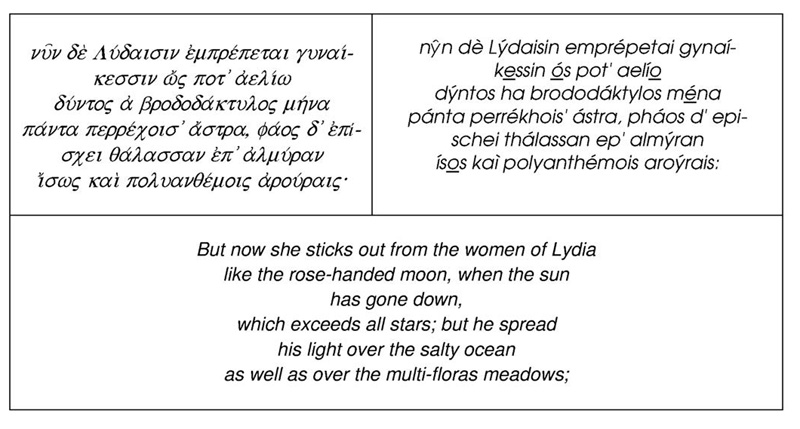
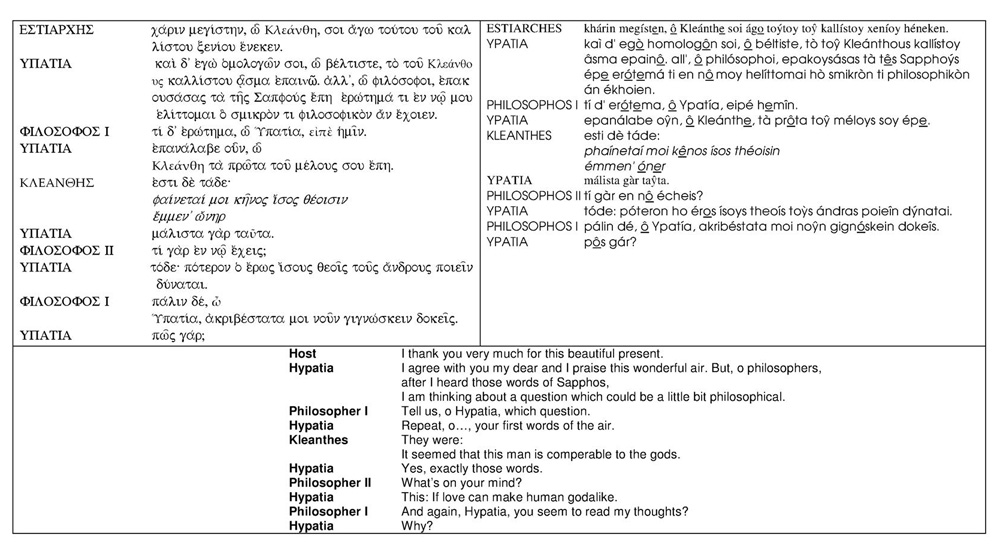
Ici vous allez trouver quelques parties du libretto en grec ancien avec une transcription phonétique en caractères latin
(à lire et à entendre) et la traduction anglaise, pour la traduction allemande veuillez cliquer s. v. p. http://www.idyllion.gr/libd.htm
Click "Play" to hear.
Download: PDF
 Download:
Download: PDF
Past Events
Selianitika 10.12.2005
The Results of the
International Composition
Competition - in honour of the Greek poet Pindar and the athletes of the ancient
Hellas
Hellenikon Idyllion spoke with the
jury member Werner Schulze, Professor at the University of Music and Art Vienna,
about the results of the international composition competition.
How did the jury judged the received compositions?
....We paid attention on certain characteristics, for example whether the five
ancient disciplines run, long jump, discus, javelin, wrestling became effective,
whether the metrical measure of Pindar’s text was converted, how the orchestra
and the choir or speakers were used or how the quality of a composition is
jugged in general. We did not prefer any specific style; It was important to try
to go towards a new direction. We examined whether the composer -by dealing with
the topic- was able to develop his own view, with the courage to find and
express his own personal language. Further it was important, that people who are
interested in music are able to find an access to the musical representation of
the topic. The piece of work, which had a too popular style or on the other hand
a too avant-garde style one was less in demand.....(The
hole interview with Prof. Werner Schulze can be read at the end of this
message.)
more information about the
Composer's Competition
Twentyone compositions from eleven countries - Brazil, Canada, USA, Australia, Japan, Austria, Finland, Germany, Greatbritain, Greece and Spain – were submitted. The jury met on Saturday, July 12th 2003, under the presidency of the competition´s initiator Andreas Drekis at Hellenikon Idyllion. Personalities from Austria, Germany and Greece formed the jury.
Unanimously one first, two second and special prices were assigned:
1.
Price: Andrew Michael March (London, Greatbritain)
- "5 Songs of Pindar" for Soprano Solo, Choir und Orchestra -
(1 or 2 pianos, 2 flutes, 2 oboes, Bb Clarinets, 2 bassoons, piccolo, cor
anglais, clarinet in A, Contrabassoon, 4 french horn, 2 Bb trumpets, 2
Trombones, bass trombone, tuba, doubling trumbets in C, Timpani, bass drums, 4
low tom-toms, crash cymbals, medium stand-mounted suspended cymbal, triangle,
large tam-tam, large thunder sheet, fine grade sandpaper blocks, fine bead
maracas, crotales, chimes, Glockenspiel, marimba, 1 harp, 16 first violins, 14
second violins, 12 violas, 10 violoncellos, 8 bouble basses)
Concert in honour of the First Prize Winner
and
to hear the first taste of the
'Wrestling' discipline transforming
the ancient Greek athletic spirit into music inspired
by the text of Pindar.
click
here
2.
Price: Ken Ito (Tokyo, Japan)
-
"Choreia Pteroessa" („Flying Choir“) for
Tenor Solo, Choir und Orchestra - (2 flutes, 2nd. doubling with piccolo flute, 2
oboes, 2 nd. doubling with corno inglais, 2 clarinets in B flat, 2 bassons, 2nd.
doubling with double basson, 4 horns in F, 2 Trumpets in C, 2 Tenor Trombone, 1
bass trombone, 1 bass Tuba, Timpani, 2 suspended cymbales, 1 anvil, 1 sistre, 1
triangel, chromatic cymbales antiques (with water bath), 1 glockenspiel, 1
xylophone, 1 vibraphone (without motor, with double bass bow), 1 marimba, 1 pair
of small crush cymbales, 1 small Tam-tam (or Korean SAMULNORI middle-sized
Tam-tam), 2 tom-toms, 2 caw-bells, 1 triangle, 1 chromatic tubular bells, the
same instrument for that of Perc.3 player is available; 1 pair of large crush
cymbales, 1 gran cassa, 1 tam-tam grave, 1 snare drum, 1 pair of bongoes, 1 pair
of congas, 1 triangel, 1 chromatic tubulas bells, the same instrument for that
of Perc. 2 player is available; 1 celesta, 1 Pianoforte, 1 harp, wood winds,
brass, strings)
2.
Price:
Shigeru Kan-no (Fukushima, Japan - Hilgenroth, Germany)
- "Millenium Soldier III
- Hymnen Pindars“ for Choir
und Orchestra - (2 flutes, 2 oboes, 2 clarinets in A, 2 fagottes, 4 horns in F,
2 trumpets in C, 2 tenor trombone, bass trombone and tuba, timpani, metal
percussion, violins, violas, violoncello, contra bass)
A special price was given to Aaron David Miller (Bowling Green, Ohio, USA) - "Five Hymns of Pindar" for Soprano Solo, Tenor Solo, Choir und Orchestra. (2 flutes, 2 oboes, 2 clarinets in Bb, 2 bassoons, 4 horns in F, 2 trumpets in Bb, 3 trombones, tuba, timpani (4 drums), glockenspiel, chimes, suspended cymbal, tam-tams, bass drum, tom-toms, sleigh bells, triangel, bell tree, crotales, snare drums, violins 1&2, violas, cellos, basses)
A special price for young composers was given to
Enrique Hernandis Martínez (25 years, Cárcer/Valencia, Spain) - "The Musical Games 2004"for Choir und Orchestra.
Other compositions recommended for performance:
Gerold Amann (Schlins,
Austria)
- "Olympias Agona"
-
"Hellenikon Idyllion"
for Speaker and Orchestra
- "Olympic Music"
for Speaker and Orchestra
-
"Pindar´s Hymns"
-
"Five Rings"
for Solo Singer, Choir and
-
"Hymns of Pindar"
for SATB Choir und
The jury was impressed by the general high level of the submitted compositions. In total the compositions solved the competition´s task, to remind the present on the antique olympic games, in an outstanding way.
Initiator of the competition:
Andreas Drekis
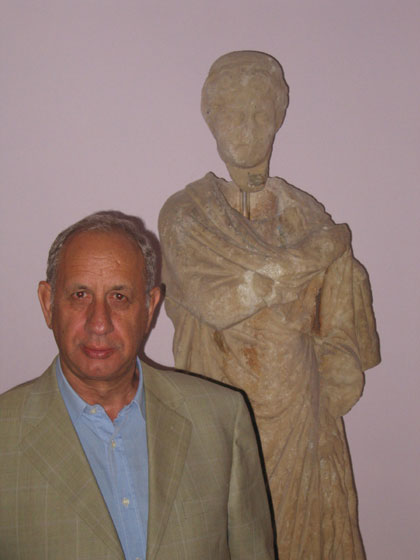
Manager of the cultural centre “Hellenikon Idyllion”
Jury:
Alois Springer

Principal conductor, director of music
Frankfurt/Main
Werner Schulze

University professor for music and representing art Vienna, composer
Vienna
Rafaïl Pylarinos

Conductor, composer
Athens, Greece


Andreas Drekis, Rafaïl Pilarinos, Werner Schulze Rafaïl Pilarinos,Werner
Schulze and Alois Springer
and Alois Springer
1st Prize
Andrew Michael March


Andrews Biographie :
Born 1973, studied composition and orchestration with Jeremy Dale Roberts at the Royal College of Music from 1992 - 1996 gaining BMus (Hons) RCM.
Performances
(inter alia)
Marine - à travers les arbres
(1997) Moscow Radio Symphony Orchestra
European Union Youth Orchestra, Conductor Vladimir
Ashkenazy
A Stirring in the Heavenlies (2000)
London Symphony Orchestra, (World Premiere)
Nymphéas for 2 Pianos (2002) piece was premiered in the Royal Palace, Stockholm in Autumn
2002, and received a total of 5 live performances in and around
Scandinavia in 2002
Awards
(inter alia)
1996
Winner at The Royal Philharmonic Society Composition Prize
1998 Winner
at Masterprize International Composing Competition
 PINDAR - the greatest lyric
poet of Ancient Greece522 - 446 v.Ch.
PINDAR - the greatest lyric
poet of Ancient Greece522 - 446 v.Ch.
Concert in honour of the First Prize Winner and to hear the first taste of the 'Wrestling' discipline transforming the athletic spirit into music inspired by the text of Pindar.
Pindar-Text Song Video with choir (half) (Click the right mouse button and press SAVE TARGET
Video "Pale"with Choir
(full)" He Pale"
"Wrestling"
 T
T
his competition discipline "Wrestling" is performed by the
Chorus Urbanus of Gozo (Malta) in the Ancient Greek language with piano instead
of orchestra. The conductor was John Galea. The concert took
place in the Archeological Museum in Egion, September the 20th /
2003. Present at the concert; (pictured above left), was the
Mayor of Egion, Mr. Andreas Drekis President of Hellenikon
Idyllion,
composer Enrique Hernandis Martínez
winner of the Young Persons' Prize, the composer
Andrew March winner of the 1st Prize and the president of Chorus
Urbanus. Also present was competition jury member Alois
Springer, the Chief of Police for Egion, the High Priest of the
Greek Orthodox Church and Professors of the University of
Patras.
A pretaste of the other
future performances of all honored compositions worldwide
with symphonic orchestra and choir.


English Translation:
- "5 Songs of Pindar" -

Born 1973, studied composition and orchestration with Jeremy Dale Roberts at the Royal College of Music from 1992 - 1996 gaining BMus (Hons) RCM.
Performances
(inter alia)
Marine - à travers les arbres
(1997) Moscow Radio Symphony Orchestra
European Union Youth Orchestra, Conductor Vladimir
Ashkenazy
A Stirring in the Heavenlies (2000)
London Symphony Orchestra, (World Premiere)
Nymphéas for 2 Pianos (2002) piece was premiered in the Royal Palace, Stockholm in Autumn
2002, and received a total of 5 live performances in and around
Scandinavia in 2002
Awards
(inter alia)
1996
Winner at The Royal Philharmonic Society Composition Prize
1998 Winner
at Masterprize International Composing Competition
2nd Prize
Ken Ito

- "Choreia Pteroessa" („Flying Choir“) -

1965 in Tokyo, studied composition, piano, cello and physics in Tokyo.
Positions Held (inter alia)
Present
• Professor of
composition and conducting, University of Tokyo
• Commissions of Composing
and Conducting
• Music Technological
Collaboration with bigger Japanese companies
• Colaboration with visual
media
Performances (inter alia)
1998
Orchestra Director of posthumous work by John Cage "Ocean" together
with Merce Canningham and his Dance Company
2001
recording Beethoven´s "Symphony No. 5 " and Tchaikovsky´s
"Violin Concerto"
2002
Conducting Japan Yomiuri Symphony Orchestra
Awards (inter alia)
1993
Awarded 1st Prize of Tokyo Metropolitan Competition of
Orchestra
Composition
1999
Awarded Toru Takemistu Award judged by Luciano Berio
2nd Prize
Shigeru Kan-no

- "Millenium Soldier III - Hymnen Pindars“ -

Born 1959 in Fukushima/ Japan, studied music and musicology in Tokyo, conducting at the college of music Vienna, composition at the college of music Stuttgart and conducting and composition at the college of music Frankfurt from 1980 - 1997.
Performances (inter alia)
1986 - 1992
conducting for example with the Tokyo Symphonie Orchestra and the Radio Symphonie
Orchestra Stuttgart particularly within the range of "New Music"
1992
Assistent for Professor Karlheinz Stockhausen with Ensemble Modern
Frankfurt
since 1998
conduction for
example at the Lisboa Philharmonic Orchestra and National Symphonie
Orchestra Uzbekistan
Awards (inter alia)
2000
2nd Prize at Quebec/Canada French Chorus Composition Concour
2001
3rd Prize at 2 Agosto in Bologna/Italia
2001
1st Prize at Cantus Ensemble in Croatia
Special Prize
Aaron David Miller
- "Five Hymns of Pindar" -

born 1972, studied Composition and Organ Performance at the Manhattan School of Music, New York, NY, graduated D.M.A. in 1999
Positions Held (inter alia)
1998 - 2002
several larger compositions and public recording, especially for organ
2001 - 2002
several professional engagements for festivals in the USA
1997 - present
Assistant Musicologist, Scarsdale, NY
Music transcriptions and analysis for copyright infringement disputes
Awards (inter alia)
1998
Improvisation and Bach Prizes, Calgary International Organ Festival and
Competition, Calgary, Canada
1999
Helen Cohn Award for Research in Medieval and Renaissance Music,
Manhattan School of Music, New York, NY
Special Prize for young composers
Enrique Hernandis Martínez

- "The Musical Games 2004" -

born 1977 in Spain, studied music in Valencia and graduated "Profesor de Percusión, Composición e Instrumentación" (2000).
Positions Held (inter alia)
Present
• Director de la Unión Artística Musical de
Navajas (Castellón)
• Professor de Armonía, Análisis y
Fundamentos de Composición
en los Conservatorios Profesionales de Chella y Amussafes (Valencia)
• several recordings for Orchestra for brass
band and
Symphonyorchestra
• several broadcasts at Spanish broadcasting
stations
Awards (inter alia)
2001
1st Price in Concurso Nacional de Composición Musical"Ciudad de
Alicante"
2002
1st Price in Concurso de Composición de Tolosa (Guipúzcoa)
Other compositions recommended for performance:
Gerold Amann

-
"Olympias Agona" -
born 1937 in Voralberg/Austria, studied (i.a.
Dinos Constantinides

- "Hellenikon Idyllion" -
studied first in Athens and later Composition und Violin in U:S:A:, Boyd Professor und Coordinator of
Composition at the School of Music at Louisiana State University
Claude Lachapelle

- "Olympic Music" -
born 1951 in Drummondville (Qu
Spiros Mazis

born 1957 at Korfu, studied (i.a.) Composition, Director of the "Classic and Contemporary Music and Center of Elektronic Music" Conservatory in Athens
- "Pindar´s Hymns" -live recording from the anthems of Pindar
 in
the ancient theatre of Argos
in
the ancient theatre of Argos
in the context of the
composer competition of Hellenikon
Idyllion, a composition of Spyros Mazis,
staged
in the ancient theatres of Oiniades and in Argos, which is acted
and sung by the orchestra and the choir of the opera studio Meran
in Italy
supervised by
Prof.
Richard Sigmund
to
download click here
(mpg
1MB)
born 1957 at Korfu, studied (i.a.) Composition, Director of the "Classic and Contemporary Music and Center of Elektronic Music" Conservatory in Athens
Tina Ternes

- "Five Rings" -
born 1969 in Kaiserslautern/Germany, studierd (i.a.) School- and Filmmusic, Collegeteacher
John White

- "Hymns of Pindar" -
studied Cello und Composition, Ph.D., Professor for Music
Interview: 12.07.2003
“… that’ s the athletic idea!”
Hellenikon Idyllion spoke with the jury member Werner Schulze, Professor at the University of Music and Art Vienna, about the results of the international composition competition.
HELLENIKON IDYLLION: Did you expect that so many composers from all over the world would develop such an enthusiasm for this competition?
SCHULZE: To be honest: No! The task was not that simple to solve, because there were ancient Greek texts and sports of the ancient games supposed to be converted into music. As you know ancient Greek is not spoken any longer nowadays as well as it is taught less and less. We were very happy about such a worldwide interest. However without Hellenikon Idyllion and the initiator of this competition, Andreas Drekis, it wouldn’t be possible to make it that known. Indefatigable he sent electronic post to every kind of musical institution around the world and answered a multiplicity of questions. A big “Thank You” to him.
Classical music and the athletic games, how does this fit together?
For us it was important to express the ancient athletic idea with the means of the art of music. Moreover sports training and artistic activity were both an equivalent part of an extensive education in the antiquity. Sports and art were regarded as absolutely equal and important.
How did the jury judged the received compositions?
We paid attention on certain characteristics, for example whether the five ancient disciplines run, long jump, discus, javelin, wrestling became effective, whether the metrical measure of Pindar’s text was converted, how the orchestra and the choir or speakers were used or how the quality of a composition is jugged in general. We did not prefer any specific style; It was important to try to go towards a new direction. We examined whether the composer -by dealing with the topic- was able to develop his own view, with the courage to find and express his own personal language. Further it was important, that people who are interested in music are able to find an access to the musical representation of the topic. The piece of work, which had a too popular style or on the other hand a too avant-garde style one was less in demand.
Could you tell more details about the participants?
We received twenty-one compositions from four continents; among them there were two female composers. We were glad to see that also younger musicians took part in the competition.
Is it known already, when and where the compositions are going to be presented for the first time?
For a first impression, an orchestra is planning to play a concert on the island Kefalonia, in Olympia, in Corinth, in Galaxithi near Delphi and at Hellenikon Idyllion in the end of July End of July. Where honored pieces will be presented. Furthermore two recommended compositions for representation will be presented for the first time this July and September in concerts, in Athens, Olympia und Corinth.
So far a successful competition?
Absolutely! Noticeable was the generally good dealing with the verse measure of
the Pindar text. And it was marvelous to hold works in our hands from all over
the world-from Brazil to Australia- that represents exactly the ancient Greek
athletic Idea
For scholars, students and those who are especially
interested
in classical greek.
For more information click: program
and Classical Greek
Planned are concerts in Nikea Athens in Kipotheatro at 19. 9. , 21.00 h and in Egion in archeological museum at 20.9. , 21.00 h with music from operas, international volksongs and as a high point music with texts by Pindar from our international music composition competition Olympia 2004 Entrance free!
More information about the concert schedule shortly

The Chorus Urbanus, established in 1975, is nowadays considered as one of the best choral groups in Malta. Ever since its formation as the resident choir of St George's Basilica in Victoria, the choir has always strived to attain high levels of musical quality.
Mu
JOHN GALEA was born in Malta in 1960. After his early musical training as pianist, obtaining the Fellowship of Trinity College (London) and the Licentiate of the Royal Schools of Music (London) in Pianoforte performance, he graduated with honours at Durham University studying composition.
He has also studied musicology at the Universita` degli Studi di Pavia.
John Galea studied contemporary composition techniques with Charles Camilleri, furthering his studies with Franco Donatoni at the Fondazione Romanini in Brescia. His compositions have been performed in Malta, Greece, France, Italy and the UK. He has also been invited to sit on the judging panel of the prestigious Valentino Bucchi competition in Rome.
Since 1978 John Galea has been a regular guest conductor with the Manoel Theatre Orchestra. During 1998-99 he was appointed Principal Conductor of the National Orchestra of Malta. As musical director of Opera Studio in Malta (1990-93), he collaborated with Professor Dobreva in realising various operatic productions at the Manoel Theatre, Valletta. John Galea has been the musical director of the Chorus Urbanus since 1979. Lately, John Galea has been commissioned to prepare a performing and critical edition of Nicolo` Isouard's Messa Leggiera (1795) which has been recorded on CD, featuring the Sofia Symphony Orchestra and the Chorus Urbanus. Under his direction, the Chorus Urbanus has toured the Vatican, Nottinghamshire, Sofia, Budapest and Vienna.
During September - October 2002, Mr. John Galea directed "The Merry Widow". This Chorus Urbanus Production featured the Chorus Urbanus and its leading soloists as the main protagonists of this production.
-______________________________________________________________________________________________________
Agon Aretes 2005 - Results
Statement and awarding of the prizes from the jurymembers Prof. Dr.Werner Schulze - University of Arts and Music Vienna, Helmut Quack - Graecist, Husum und Julia Diamantopoulou - Graecist, Athen.
The number of contributions and their quality surprised us:
26 contributions were made - more by women than by men – from 3 nations (23 Germany, 2 Argentina, 1 Spain). The group of pupils (16-18 years) entered the majority of 23 works in the contest. The task was hard. It demanded both intellectual and creative content. An equally great level for the text and the poster was hard to achieve. That is the reason why we decided to honor everyone with a prize. We suggest to award a special prize to the best poster: Nadine Steiner from Germany. She entered 2 posters. Quote Werner Schulze: “Both on a very nice artistic and philosophical level.”
A special prize for originality will go to MARIA PÄTZOLD- student in Leipzig. Her contribution is text and poster in one. An additional special prize is awarded to MARIA ALEXANDRA LÓPEZ GABRIELIDIS (Universidad Nacional de Cuyo) from Argentina for her high quality text and poster.
The contribution from EVA BOTTLER (Kaiser-Heinrich-Gymnasium) from Germany is also worth a special prize. Quote Helmut Quack:” Eva Bottler chose a more original saying and appropriately used Christian thoughts to support her argumentation. She also give a more elegant reason for learning Greek. GERRIT KURZT (Kieler Gelehrtenschule), JUDITH HOF (Johannes-Turmair-Gymnasium Straubing), THOMAS ROSENHAMMER (Robert-Schumann-Gymnasium), EVA HENKE (Katharineum zu Lübeck), MAXIMILIANE BERGER (Gymnasium Casimirianum Coburg), JÖRG VON ALVENSLEBEN (Katharineum zu Lübeck) from Germany and CRISTINA RADOS (Universidad del Salvador) from Argentina also deserve a special award for their exceptional work. In the group of students we award one special prize to ADRÈS MOULINS (Universidad National de Cordoba).
For the first prize in the categorie for pupils we suggest KLEONIKI RIZOU (Kieler Gelehrtenschule) from Germany. Both the expressive poster and the text are exceptional.
Quote Helmut Quack: “Kleoniki Rizou enchants the reader by her casual and easy tone. The big words which usually describe ideals about education are totally missing. Like a new Alice in Wonderland she takes the reader by the hand and awakes in him the same love for the greek language abd culture that live in her.”
JOHN RAUTHMANN
(Augustinus-Gymnasium Weiden)
from Germany
is one who wrote his complete text in ancient Greek and is awarded the first prize.
A commentary by Julia Diamantopoulou:”Flawless use of the attic dialect combined with his own style. Felicitous examples in every area to illustrate the philosophical saying. His own conclusions about wisdom and the happiness that the learning of the ancient Greek language gives one form the details no matter if the language is still spoken or not.
The young people found a lot of good arguments for the protection of the ancient Greek. Plenty of enthusiasm for the Greek culture and language were expressed. The contributions which were awarded a price were those which took a less well known philosophical saying as a basis for a high quality analysis and an artistic poster.
The prizes are:
For the first place a written recognition and a big briefcase with stamps from the Olympic Games 2004 in Athens with the title “the champions” and a two weeks stay with a companion in Hellenikon Idyllion.
The special prize is a special briefcase from the Olympic Games 2004 in Athens.
All special price winners and all other participants with their interesting contributions will get a written recognition by mail and a one week stay at Hellenikon Idyllion ( time of stay only in accordance with prior arrangement).
It was not easy for us to choose the winners from the great variety of contributions. The great distance made the collaboration with the jury members also difficult.
We apologize for the late Announcement of the competition results. We would like to publish your photo aside your text and poster on our website if you send us one.
Thank you for your participation
The jury members Prof. Werner Schulze, Helmut Quack, Julia Diamantopoulou and the initiator and benefactor Andreas Drekis (founder and manager of Hellenikon Idyllion)
_______________________________________________________________________________________________________
Bizet from the opera "Habanera", Carmen
Video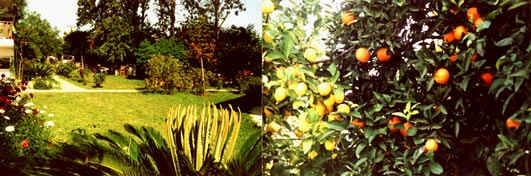
In Hellenikon Idyllion greek
music!!
Song "Ximeroni" from Manos
Chatsidakis.
The young symphony orchestra
from Fuerth/Germany
Here the story goes, Archileus was dipped into the famous spring Styx held at his heel by his mother Atthis.
Therefore he became invulnerable with the exception of his heel.
More
Informations about
"A
bukolic concert in a mythological atmosphere...."
please click
Press
------------------------------------------------------------------------------
Historical video
from July 1993
in the garden of Hellenikon Idyllion
(at that time still without wooden stage)
with the young symphony orchestra from Leipzig (100 musicans).
Rehearsal of the famous greek Song "Samiotissa"
with the sopranist Barbara Luther
and the tenor Nikos Voutsinos
(Deutsche Oper Berlin)
Conductor: Iwan Ivanov
retour home